
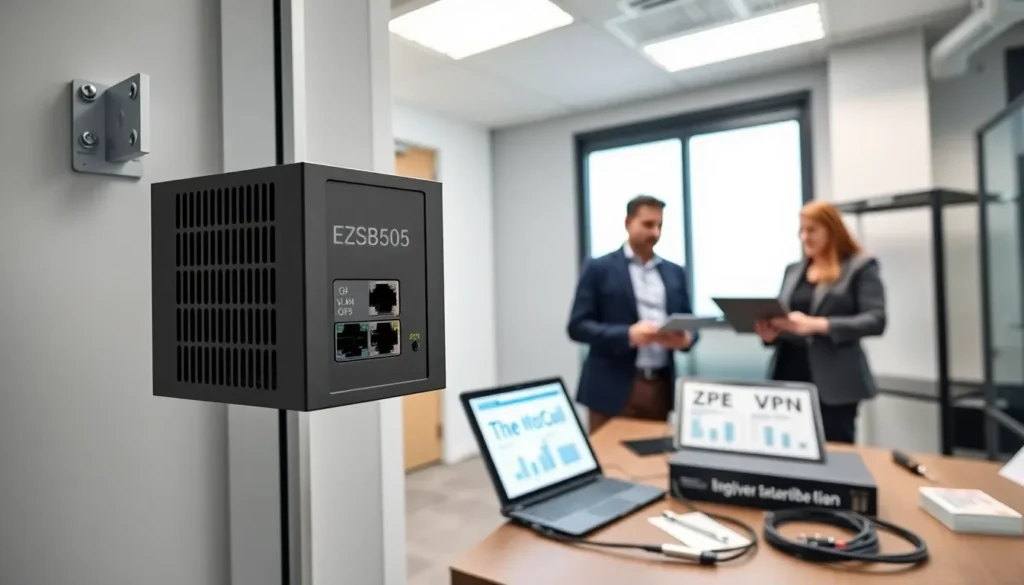

EZS8505 is a compact networking module that targets small teams and field technicians. It delivers reliable throughput and low power draw. The article explains its specs, setup steps, common fixes, and buying advice.
Table of Contents
ToggleKey Takeaways
- The EZS8505 is a compact, fanless edge router ideal for small offices, retail sites, and mobile teams that need reliable throughput with low power draw.
- With a quad-core ARM CPU, 2 GB RAM, two gigabit ports plus SFP, and support for OpenVPN/WireGuard, the EZS8505 delivers up to ~900 Mbps NAT-free routing and 200–300 Mbps encrypted tunnel throughput.
- During setup, mount near existing cabling, change the default password, configure VLANs/DHCP/firewall rules, disable unused services, and schedule daily configuration backups and firmware logging.
- Troubleshoot connectivity by checking link lights and WAN sync, using SSH when the web UI fails, restoring a known-good backup after bad configs, and monitoring CPU/memory and packet drops for performance issues.
- When buying an EZS8505, verify the hardware revision, included accessories, firmware update policy, warranty/return terms, and reseller options for radio modules or mounting kits.
What The EZS8505 Is And Who It’s For
The EZS8505 is a single-board network device that firms use for edge routing, VPN endpoints, and wireless bridging. It suits small offices, retail sites, and mobile teams. IT managers pick the EZS8505 when they need steady connections and a small footprint. Field technicians pick the EZS8505 for its simple mounting and predictable behavior. The device ships with a metal enclosure and fanless cooling. It runs a lightweight Linux build and supports common routing protocols. Buyers choose the EZS8505 when they want a compact device they can install quickly and maintain with minimal training.
Key Technical Specifications
The EZS8505 uses a quad-core ARM processor and 2 GB of RAM. It includes two gigabit Ethernet ports and one SFP port. The device ships with 16 GB of eMMC storage. It supports 802.11ac on an optional radio module. Power input accepts 12–24 VDC. The unit consumes 6–10 W in typical operation. The firmware supports VLANs, QoS, and basic firewall rules. The device accepts a microSD slot for storage expansion. The build supports OpenVPN and WireGuard. The vendor rates MTBF at 50,000 hours. The hardware meets CE and FCC marks.
Performance Highlights And Real-World Use Cases
The EZS8505 routes traffic at up to 900 Mbps for NAT-free flows. It handles encrypted tunnels at roughly 200–300 Mbps depending on cipher choice. For office Wi-Fi backhaul, the device sustains stable throughput for 10–15 users. For retail PoS links, the EZS8505 provides predictable packet delivery and quick failover. In vehicle deployments, the module survives vibration and temperature swings. The device performs well as a failover gateway when paired with a cellular modem. Field teams report easy diagnostics and fast swap-outs. Network engineers use the EZS8505 to offload basic edge tasks and keep core routers free for heavy workloads.
Setup, Installation, And Best Practices
The installer mounts the EZS8505 near existing cabling and power. They connect the WAN port to the upstream modem and the LAN port to the switch. They power the unit and access the web UI via the default IP. The admin changes the default password immediately. The admin applies a small configuration: VLANs for segmentation, DHCP for client addressing, and firewall rules that block unwanted input. The installer disables unused services to reduce attack surface. The admin schedules daily configuration backups. The team logs firmware versions and change dates. For remote sites, they enable secure remote access with key-based SSH and limit access by source IP where possible.
Troubleshooting Common Issues
If the EZS8505 loses connectivity, the technician first checks link lights on the Ethernet ports. They confirm WAN sync from the upstream device. They then ping the gateway from a local laptop. If the web UI fails, they try SSH to check running services. If a recent config change caused failure, they restore the last known-good backup. If performance drops, they inspect CPU and memory metrics and check for packet drops on interfaces. For intermittent wireless issues, they verify channel settings and nearby interference. If the unit fails to boot, they attempt a safe-mode boot and reflash the firmware if needed. They document every step and time of the fault.
How The EZS8505 Compares To Alternatives
The EZS8505 favors low power and compact size over raw throughput. Competing devices may offer higher core counts and more ports. The EZS8505 wins on price per unit and ease of physical install. Some rivals include built-in cellular modems, which the EZS8505 lacks by default. The EZS8505 matches rivals on basic VPN performance but trails in heavy concurrent sessions. IT teams choose the EZS8505 when they need a small box that delivers common routing features and predictable behavior. Other buyers pick alternatives when they need many ports or carrier-grade throughput.
Buying Considerations And Where To Find It
Buyers should check the exact hardware revision when they order the EZS8505. They should confirm included accessories and warranty terms. They should review firmware update policies and vendor support hours. They should ask about return windows and bulk discounts for deployments. Authorized resellers often stock the EZS8505 with optional radio modules and mounting kits. Buyers can also find the device through major online retailers and specialized industrial networking distributors. The price varies by configuration and warranty level.
Typical Configuration Examples
Small office: WAN on port 1, LAN on port 2, VLAN 10 for staff, VLAN 20 for guest, DHCP on both VLANs. Retail kiosk: WAN plus cellular bridge, strict firewall rules, remote logging to central syslog. Mobile unit: static IP on WAN, bonded links for redundancy, automatic VPN to head office. Each example uses default CPU and memory profiles and follows minimal service enablement.