
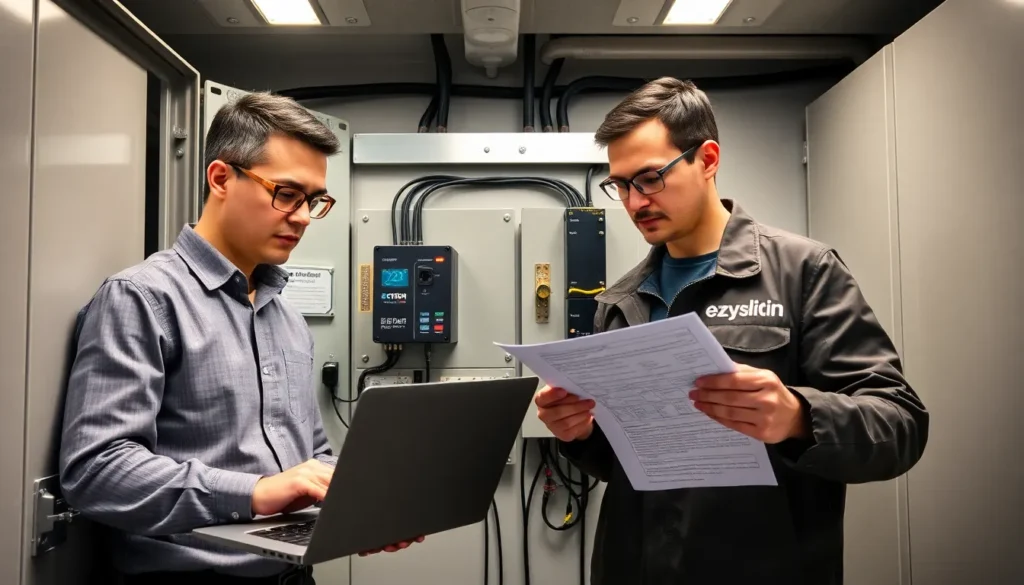

The ezy6510 is a compact industrial controller that targets small automation projects and light commercial use. It offers a clear interface and solid connectivity for users who need reliable control without high cost. This guide explains who should consider the ezy6510 and what to expect during setup and use.
Table of Contents
ToggleKey Takeaways
- The ezy6510 is a compact, low-cost PLC ideal for small automation projects like pump control, HVAC zones, and conveyor segments.
- Install the ezy6510 on a DIN rail, connect 12–24 VDC, ground the chassis, and verify wiring and LED status before loading the example program.
- Use the included programming tool to load the demo, change the IP to match your network, run in test mode, and log the first-hour behavior to catch wiring or sensor issues.
- Troubleshoot power, Ethernet, and RS-485 faults with basic checks (fuse, polarity, cable, termination) and revert firmware if problems follow an update.
- Confirm I/O counts, supported protocols (Modbus TCP/RTU, HTTP), and warranty before buying, and consider DIN-rail extenders, surge protectors, or a compact HMI as useful accessories.
What Is The EZY6510 And Who Is It For
The ezy6510 is a programmable logic controller in a small form factor. It runs simple control logic and handles sensor input and actuator output. Companies buy it for pump control, HVAC zones, conveyor segments, and light machine control. Small shops buy it for retrofits and prototypes. Facility managers choose it when they need a low-cost, easy-to-deploy controller.
The device targets technicians, small business owners, and field engineers. Technicians use it for repeatable control tasks. Engineers use it for quick proof of concept. Owners use it to cut repair time and reduce downtime. The ezy6510 fits projects that do not need heavy-duty PLC features or large I/O counts.
The unit ships with basic documentation and a simple programming environment. It requires minimal training for users with prior control experience. New users will learn the interface in a few hours and apply common templates to get a system running.
Key Features And Technical Specifications
The ezy6510 blends modest compute power with practical I/O and modern communication ports. It aims to deliver dependable control and flexible integration.
Performance Specs
The controller uses a 32-bit processor and runs a deterministic control loop. It supports up to 4 kHz scan rates on core logic. It stores user programs in flash memory and keeps the clock on battery backup. Users will see consistent cycle times for small control programs.
Connectivity And Compatibility
The ezy6510 includes Ethernet, RS-485, and USB ports. It supports Modbus TCP, Modbus RTU, and simple HTTP APIs. The unit integrates with SCADA systems and third-party HMIs. It accepts common sensor signals through analog and digital channels.
Design, Build Quality, And Power Requirements
The housing uses a DIN-rail form factor and a metal backplate. It meets IP20 for basic panel protection. The unit draws 12 to 24 VDC and uses under 10 W in typical operation. The terminal blocks accept standard wire gauges and include screw clamps. The build aims to provide stable performance in normal industrial environments.
Step‑By‑Step Setup And Installation Guide
The ezy6510 installation follows clear steps that a trained technician can perform in a short time. The process focuses on safety, correct wiring, and basic configuration.
Unboxing And Preinstallation Checks
The package contains the controller, a quick start sheet, a USB cable, and mounting screws. The user should check the unit for shipping damage. The user should confirm the labeled model number and serial number. The user should update the spare parts list and record the firmware version.
Wiring, Mounting, And Initial Configuration
Install the unit on a DIN rail and secure it with the clamp. Connect the 12–24 VDC supply to the power terminals. Ground the chassis to the panel earth. Wire sensors to the input terminals and actuators to the output terminals. Tighten the screws to the torque specified in the manual. Connect Ethernet or RS-485 if remote access is needed.
After power-up, the unit runs a brief self-test. The LEDs show status for power, CPU, and network. The user should open the programming tool on a laptop and connect over USB or Ethernet. The tool will detect the device and show the current configuration.
Software Setup And First‑Time Use Tips
Load the example program from the quick start folder to confirm I/O mapping. Change the IP address to match the site network. Save a backup of the initial configuration to local storage. Run the program in test mode first and monitor inputs and outputs. The user should log the first-hour behavior to spot wiring errors or noisy sensors.
Troubleshooting Common Problems And Quick Fixes
The ezy6510 faces common faults that technicians can address with basic checks and adjustments. The following steps handle most issues without replacing parts.
Power, Connection, And Firmware Issues
If the unit does not power, the technician should check the fuse, supply voltage, and polarity. If the Ethernet link is down, the technician should test the cable and switch port. If RS-485 communication fails, the technician should verify termination and A/B polarity. If the device shows unexpected behavior after a firmware update, the technician should revert to the previous firmware and contact support.
Performance Degradation And Calibration Tips
If the control loop slows or the scan time grows, the technician should inspect the program for long blocking calls. The technician should reduce polling rates for noncritical inputs and move heavy math to scheduled tasks. For analog drift, the technician should run a simple two-point calibration for each channel and log readings before and after. The unit accepts calibration offsets in the configuration menu.
When To Contact Support Or Seek Professional Help
If the unit loses I/O intermittently after wiring checks, the technician should contact support. If the controller fails hardware self-tests or shows burned smells, the technician should power down and arrange a replacement. If the system requires a field upgrade to handle higher I/O counts, the user should consult a systems integrator.
Buying Considerations, Accessories, And Alternatives
Buyers should match the ezy6510 to the project size, environment, and future needs. The device fits small projects, but it may not suit large multi-zone systems.
What To Look For When Buying The EZY6510
Buyers should check the I/O counts, supported protocols, and power range. They should confirm the firmware update policy and warranty length. They should request a demo program or trial license when possible.
Useful Accessories And Add‑Ons
Common accessories include DIN-rail terminal extenders, surge protectors, and LED status modules. Users add a compact HMI for local control and an industrial Ethernet switch for networked sites. Spare screw terminal blocks simplify field swaps.
Comparable Models And Alternatives To Consider
For slightly larger needs, buyers may compare the ezy6510 to mid-range PLCs from established brands. For low-cost single-function control, programmable relays offer a cheaper option. For high-channel systems, a modular PLC with hot-swappable I/O may suit better. Buyers should list exact I/O and protocol needs before they decide.