
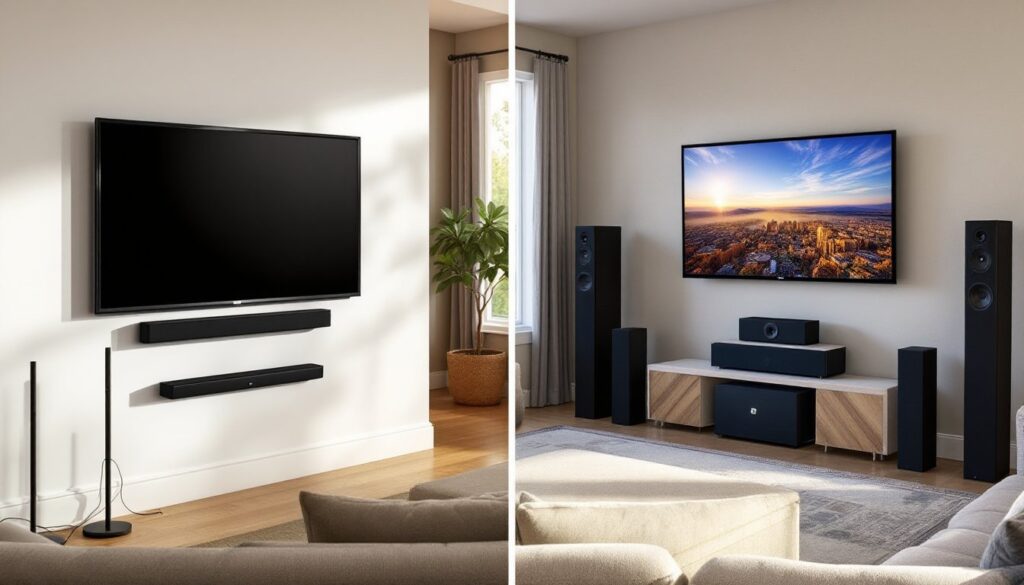

When you’re standing in front of a TV deciding whether to upgrade your audio, the choice between a soundbar and a full home theater system can feel overwhelming. Both promise better sound than your TV’s built-in speakers, but they take very different paths to get there. A soundbar is a compact, all-in-one solution that sits beneath or above your screen, while a home theater system spreads speakers around the room to create an immersive surround sound experience. The right choice depends on your room size, budget, listening habits, and how much complexity you’re willing to live with. This guide breaks down the key differences, performance trade-offs, and practical considerations so you can make an well-informed choice for your space.
Table of Contents
ToggleKey Takeaways
- A soundbar is a compact, all-in-one solution ideal for small to mid-sized rooms and centered seating, while a home theater system delivers true surround sound imaging through multiple speakers positioned around the room for cinematic immersion.
- Soundbars cost between $150–$1,500 with minimal installation, whereas a full home theater system typically ranges from $800–$4,000+ plus installation labor, making soundbars more budget-friendly upfront but potentially shorter-lived as audio formats evolve.
- Choose a soundbar if you prioritize convenience, dialogue clarity, and visual simplicity in a rental or small space; choose a home theater system if you own your home, have a dedicated media room, and want genuine surround sound performance for movies and gaming.
- A hybrid approach—pairing a quality soundbar with wireless surround speakers—offers a middle ground that costs less upfront and allows you to test surround sound tolerance before committing to a full receiver-based setup.
- A soundbar’s audio quality drops significantly when you sit off to one side, while a properly installed home theater system provides directional accuracy that creates measurably better immersion and object positioning around the listening space.
Key Differences Between Soundbars and Home Theater Systems
A soundbar is a single, unified speaker bar, typically 2 to 4 feet wide, that houses multiple drivers (the individual speaker elements) in one enclosure. Most soundbars sit on a TV stand or mount on the wall below a screen. They process stereo and surround sound signals and output them through a concentrated speaker front, sometimes with a wireless subwoofer for bass. No wiring mess, no speaker placement logistics.
A home theater system, by contrast, is modular. It includes a center channel speaker (clarity for dialogue), left and right front speakers (main audio), surround speakers (ambient sound from the sides or rear), and a subwoofer. Some setups add height speakers for overhead sound effects. Each speaker sits in its designated spot around the room, wired to an AV receiver, the brain that decodes audio signals and sends them to the right speaker at the right time.
The fundamental difference: a soundbar gives you convenience and visual simplicity, while a home theater system gives you audio precision and true surround sound imaging. One is a plug-and-play convenience: the other is a carefully orchestrated performance. Neither is inherently “better”, context matters.
Performance and Audio Quality Comparison
Soundbar Audio Capabilities
A good soundbar can deliver impressive sound for its size. Better models use digital signal processing to simulate surround sound by bouncing audio off walls or using psychoacoustic tricks, your brain fills in the gaps. If you sit directly in front of the TV, a soundbar with a quality center channel will make dialogue crisp and clear. Stereo separation (the sense that sounds come from the left or right) works well when you’re in the sweet spot.
The catch: sound quality drops noticeably if you sit off to one side. A soundbar also struggles to create the sense of an object moving around you, since all audio is emanating from a single location. Bass response depends entirely on the bundled or paired subwoofer, decent ones go low, but they won’t fill a large room the same way a dedicated home theater subwoofer will. Many soundbars max out at 3D audio (like Dolby Atmos), where they fake height effects rather than deliver true overhead sound.
Home Theater Surround Sound Experience
A properly set up home theater system places sound exactly where it belongs. When an actor walks from left to right, you hear them move across the front. When a plane flies overhead, dedicated ceiling speakers (or upward-firing drivers) create genuine height. This spatial accuracy is thrilling for movies and games, it’s the difference between watching and being there.
Because each speaker is optimized for its role, you get better dialogue clarity, more controlled bass, and fuller ambient soundscapes. Recent research shows that surround sound systems create measurably better immersion than compressed soundbar algorithms. The trade-off is room-dependent performance: if your sofa is too close to a surround speaker or off-center, the effect breaks down. Sound staging requires thoughtful placement and sometimes acoustic treatment.
Cost and Installation Considerations
Budget-conscious shoppers often default to soundbars because the entry price is low, good models start around $150 to $300. A $500 to $1,500 soundbar with a subwoofer delivers respectable performance for most living rooms. You’re looking at a single box, one power cord, and maybe an optical cable or HDMI connection to your TV. Setup takes minutes.
Home theater systems demand more planning and cash. A decent 5.1 setup (five speakers plus a subwoofer) typically costs $800 to $2,500, depending on speaker quality. A 7.1 system (adding two side surrounds) pushes toward $1,500 to $4,000 or more. The AV receiver itself, the piece that ties everything together, adds $300 to $1,000 on top of that. You’re also factoring in wiring, speaker stands, wall mounts, and potential drywall repair if you’re running speaker cables through walls.
If installation labor is involved (running in-wall wiring, building a proper cabinet for the center speaker), you could add $500 to $2,000. But, a home theater system’s cost-per-year is often better in the long run because you’re not replacing components as frequently. Soundbars age faster: their digital processing can’t keep pace with new surround formats the way a receiver-based system can (a new receiver costs far less than replacing an entire soundbar).
Permits are rarely required for either setup unless you’re cutting into load-bearing walls for wiring. If you’re uncertain about wall access or cable routing, check with a local electrician, codes vary by jurisdiction.
Space and Aesthetic Factors
Soundbars win decisively on footprint. A sleek 2-foot soundbar takes up negligible real estate, and wall-mounted models vanish visually. If your living room is modest, your media console is tight, or you rent and can’t drill into walls, a soundbar keeps things clean and simple. Many modern TV stands already account for a soundbar’s depth, so integration feels intentional.
Home theater systems demand room commitment. Front speakers need stands or wall mounts on either side of the TV. Surrounds go on side walls or rear walls, sometimes at ear level or slightly higher. A subwoofer, typically a 12- to 15-inch cube, needs a corner or visible placement. For cable routing, you’ll either run wires along baseboards (visible) or fish them through walls (invisible but riskier without professional help). The visual footprint is larger, though a well-designed setup can look purposeful rather than chaotic.
If your room is open-concept or you prioritize a minimalist aesthetic, the soundbar’s simplicity is compelling. If you have a dedicated media room or don’t mind a theater-like appearance, the hardware becomes part of the design. Some homeowners even celebrate the look, recessed speaker grilles, stands that frame the TV, and a visible subwoofer can signal “real audio investment” to visitors. Recent comparative reviews of soundbars highlight how modern aesthetics have improved, making many models blend seamlessly with contemporary decor.
Which Option Suits Your Lifestyle and Needs
Choose a soundbar if you watch mostly TV shows, news, and streamed content: watch from a centered seating position: rent or move frequently: want zero installation hassle: or have a small to mid-sized room (under 250 square feet). Soundbars shine for people who care more about convenience and dialogue clarity than cinematic immersion. They’re also the pragmatic choice if wall damage or visible wiring would be a dealbreaker.
Choose a home theater system if you’re a movie or gaming enthusiast who values spatial audio and wants true surround sound: own your home and plan to stay: have a dedicated media room or don’t mind dedicated audio space: are comfortable with installation work (or willing to hire it out): or have a larger room (300+ square feet) where a soundbar’s directional limitations become obvious. A home theater system is the right call if you’ve already invested in a quality TV and high-speed internet for 4K streaming, your audio setup should match that commitment.
Middle ground: hybrid systems exist. Some people buy a quality soundbar plus add wireless surround speakers later. This approach costs less upfront, is easier to install, and lets you test your tolerance for surround sound before committing to a full receiver-based setup. It’s not a true home theater experience, but it bridges the gap. Eventually, consider how you actually spend your time in front of the TV, not how you think you should. A soundbar you enjoy using beats a home theater system gathering dust because setup felt overwhelming.
If you’re torn, professional reviews like this soundbar versus home theater comparison can walk through real-world performance and help you weigh the trade-offs for your specific situation. Visit a local electronics retailer if possible, listen to demo units in a controlled environment. The right choice is the one that fits your room, your budget, and your actual viewing habits, not an idealized version of yourself.